Anthropic Conceptual Reasoning Fellowship 2027: $100,000–$167,000 for a Four-Month AI Research Fellowship in the USA

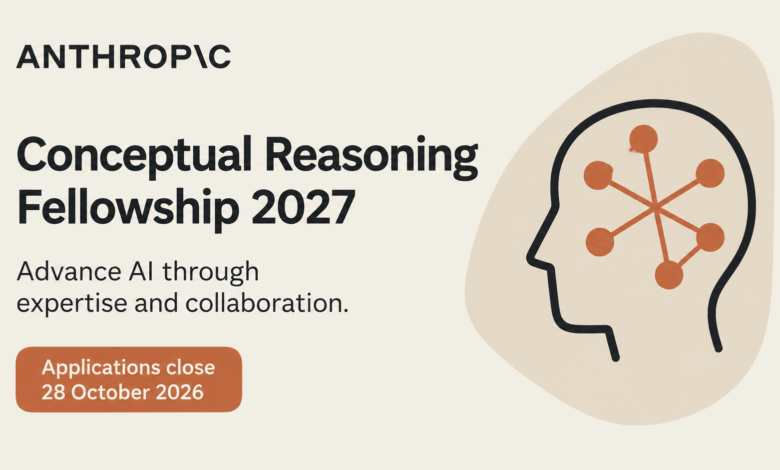
Table of Contents
The Anthropic Conceptual Reasoning Fellowship 2027 is an exciting opportunity for researchers and subject-matter experts in philosophy, cognitive science, economics, public policy, and law to work with advanced artificial intelligence (AI) systems. Hosted by Anthropic, the fellowship offers a four-month, full-time research opportunity focused on evaluating, improving, and applying Claude AI to complex problems that require expert judgment and conceptual reasoning.
The Anthropic Conceptual Reasoning Fellowship provides compensation of $100,000–$167,000 USD for the four-month program, equivalent to an annualized rate of $300,000–$500,000 USD, together with other benefits. The fellowship is scheduled to run from January 12 to May 8, 2027, and applications are open until October 28, 2026.
Based in San Francisco, California, the program may also consider remote engagements within the United States under certain circumstances. Candidates must have existing or independently obtained authorization to work full-time in the United States throughout the fellowship.
Researchers interested in AI safety, expert-level reasoning, model evaluation, and interdisciplinary research are encouraged to explore this opportunity.
ALSO READ: Princeton in Africa Fellowship 2027–2028 | Paid Postgraduate Fellowship Opportunities Across Africa
Anthropic Conceptual Reasoning Fellowship 2027: Overview
- Host Organization: Anthropic
- Fellowship Name: Conceptual Reasoning Fellow
- Program Type: Paid AI research fellowship
- Location: San Francisco, California, United States; selected remote arrangements within the United States may be considered
- Duration: Four months
- Program Dates: January 12–May 8, 2027
- Compensation: $100,000–$167,000 USD for the four-month fellowship
- Annualized Compensation Equivalent: $300,000–$500,000 USD
- Fields of Interest: Philosophy, cognitive science, economics, public policy, and law
- Academic Level: PhD holders, PhD candidates completing their degrees, or candidates with equivalent research experience
- Work Schedule: Full-time
- Application Deadline: October 28, 2026
- Expected Offer Date: November 20, 2026
- Visa Sponsorship: Not available for this fellowship
- Official Application: https://job-boards.greenhouse.io/anthropic
Candidates should consult the official vacancy for the complete eligibility requirements, contract conditions, and application instructions.
About Anthropic
Anthropic is an artificial intelligence company focused on developing reliable, interpretable, and steerable AI systems. Its mission is to ensure that advanced AI is safe and beneficial for users and society.
The organization brings together researchers, engineers, policy specialists, and business professionals to address important challenges in AI development and deployment.
Anthropic’s research emphasizes the development of trustworthy AI systems, interpretability, and methods for understanding and improving model behavior. Its work also explores how advanced AI can assist with complex questions that do not always have straightforward or easily verifiable answers.
Through the Conceptual Reasoning Fellowship, Anthropic aims to bring experts from different academic and professional disciplines into its research environment. Fellows will work with Claude, Anthropic’s AI model family, to investigate difficult problems, evaluate model capabilities, and develop systematic ways to measure reasoning performance.
What Is the Anthropic Conceptual Reasoning Fellowship?
The Anthropic Conceptual Reasoning Fellowship is a four-month research program designed for people whose expertise involves judgment, interpretation, analytical thinking, and complex problem-solving.
Many important questions in law, economics, ethics, public policy, cognitive science, and AI safety cannot be answered through simple factual recall. Addressing these questions often requires years of specialized knowledge, careful evaluation of evidence, and an understanding of competing perspectives.
Anthropic wants to explore whether advanced AI systems can become more useful partners in solving these problems. To achieve this goal, the company is inviting researchers and experts to work alongside its research teams.
Each fellow will receive a defined research project aligned with their background, mentorship from Anthropic researchers, and access to Claude models and internal evaluation tools.
The program is not simply an opportunity to use AI in academic research. Fellows will help develop evaluations, benchmarks, and research environments that test how well Claude performs on difficult, discipline-specific tasks.
Key Benefits of the Anthropic Conceptual Reasoning Fellowship 2027
1. High-value financial compensation
Selected fellows will receive $100,000–$167,000 USD for the four-month fellowship, equivalent to an annualized compensation rate of $300,000–$500,000 USD.
The actual compensation offered will depend on the applicable arrangement and details of the position. Candidates should review the official posting for further information.
2. Access to advanced Claude AI models
Fellows will work with frontier Claude models and Anthropic’s internal evaluation tools. This access will support research into how AI systems reason, analyze information, and handle difficult questions within specialized fields.
3. Research mentorship
Each fellow will work on a concrete project with mentorship from Anthropic researchers. This provides an opportunity to develop research ideas, evaluate different approaches, and contribute to practical AI research.
4. Interdisciplinary collaboration
Participants will join a cohort of incoming fellows and connect with Anthropic’s wider research community. Collaboration will help fellows exchange ideas and develop evaluations that reflect the challenges of their respective disciplines.
5. Opportunity to influence AI development
The fellowship gives experts an opportunity to help determine how AI reasoning capabilities should be tested and improved. Their work may contribute to more rigorous methods for evaluating AI performance in areas where expert judgment is essential.
6. Experience at a leading AI research organization
Fellows will gain experience working with an AI research team focused on reliability, interpretability, and safety. This experience may be relevant to future careers in AI research, academia, public policy, consulting, and interdisciplinary technology development.
Note: The official posting confirms other benefits but does not specify every benefit individually for this fixed-term fellowship. Candidates should verify the precise benefits included in their offer.
Fields Eligible for the Anthropic Conceptual Reasoning Fellowship
The fellowship is intended for experts in disciplines where complex reasoning and specialized judgment are important.
Philosophy
Philosophers may investigate ethical reasoning, normative judgment, formal epistemology, and other questions requiring careful conceptual analysis.
A potential project could involve developing challenging ethical scenarios that test whether Claude can distinguish between competing moral principles and explain its conclusions consistently.
Cognitive Science
Cognitive scientists may explore experimental design, theories of cognition, model comparison, and the evaluation of reasoning behavior.
A possible project could involve creating tasks that test how AI models interpret evidence, compare competing explanations, and reason about human decision-making.
Economics
Economists may develop modeling problems, identification tasks, and structured questions with known or assessable answers.
Their work could help determine whether Claude can reason accurately about economic relationships, assumptions, evidence, and causal claims.
Public Policy
Policy researchers may investigate regulatory analysis, public-sector decision-making, cost-benefit analysis, and other complex societal challenges.
A potential project could involve creating expert evaluation criteria for assessing AI-generated policy recommendations and identifying weaknesses in their reasoning.
Law
Legal scholars may build datasets and evaluations relevant to legal interpretation, regulatory questions, and AI policy.
Their expertise could help test whether Claude can analyze legal materials, distinguish relevant facts, and produce reasoning that meets defined expert standards.
Candidates should identify the field most closely aligned with their expertise when completing the application.
Key Responsibilities of a Conceptual Reasoning Fellow
Successful candidates will contribute to research projects designed to evaluate and improve Claude’s reasoning capabilities.
Identifying important research problems
Fellows will identify unresolved or difficult questions in their disciplines, assess existing approaches, and investigate how Claude can help make progress on these problems.
Evaluating AI capabilities
Participants will identify major societal challenges that depend on their expertise and assess the strengths and weaknesses of Claude when addressing those challenges.
Designing evaluations and benchmarks
Fellows will design structured evaluations, datasets, and reinforcement-learning environments to test model performance systematically.
Their domain knowledge will help translate complex expert judgments into practical tests that can reveal where AI systems perform well and where they fail.
Developing discipline-specific research environments
Fellows will collaborate with researchers in their fields to create demanding tasks that test Claude’s ability to reason about difficult questions.
These environments will focus on problems requiring nuanced interpretation, analytical depth, and sound judgment rather than straightforward information retrieval.
Collaborating with Anthropic researchers
Participants will discuss research directions, work with mentors, and contribute to the broader objective of developing more capable and reliable AI systems.
Minimum Qualifications for the Anthropic Conceptual Reasoning Fellowship
Applicants should carefully review the following minimum qualifications before applying.
- Relevant academic or research background: Hold or be completing a PhD in philosophy, cognitive science, economics, public policy, or law, or demonstrate equivalent research experience.
- Practical experience with Claude: Have hands-on experience using Claude and Claude Code in everyday research or professional workflows.
- Interest in AI reasoning: Be enthusiastic about the potential for AI to help address difficult questions in a field where expert judgment matters.
- Ability to deliver results: Be comfortable working in a fast-paced, high-agency environment and producing concrete research outcomes within a few months.
- United States work authorization: Have existing authorization to work in the United States for the full duration of the fellowship.
The fellowship is intended for candidates who can combine deep subject knowledge with practical experience using AI tools.
Importantly, a PhD is not the only possible route to eligibility because the posting allows equivalent research experience. However, candidates must still satisfy the other stated requirements.
JOIN OUR WHATSAPP GROUP
Preferred Qualifications
The following qualifications may strengthen an application:
- Experience designing AI evaluations, benchmarks, datasets, or expert assessment rubrics.
- Demonstrated expertise through academic publications, research projects, scholarship, or expert-level analytical writing.
- Ability to translate complex disciplinary problems into clear and measurable evaluation tasks.
- Experience assessing the accuracy, limitations, and reliability of AI-generated outputs.
- Strong analytical, communication, and collaborative research skills.
These are preferred rather than mandatory qualifications. Applicants should focus on presenting relevant expertise and demonstrating how their experience could contribute to the fellowship’s research goals.
Representative Research Projects
Anthropic has provided examples of the kinds of projects fellows might pursue.
Philosophy: Developing challenging cases that require normative judgment in ethics or formal epistemology.
Cognitive science: Designing experimental-design and model-comparison tasks.
Economics: Creating modeling and identification problems with ground truth.
Public policy: Developing regulatory and cost-benefit analysis tasks evaluated through expert rubrics.
Law: Building datasets related to legal questions relevant to AI policy.
These examples illustrate the program’s emphasis on measurable reasoning performance. The final project will depend on the fellow’s expertise, research interests, and collaboration with potential mentors.
Duration, Location, and Program Schedule
The Anthropic Conceptual Reasoning Fellowship will run from January 12 to May 8, 2027.
The program is full-time throughout the four-month period. Some fellowships may be considered for an extension, although an extension is not guaranteed.
The default work location is San Francisco, California. Anthropic will consider remote engagements within the United States in certain circumstances.
All fellows are expected to attend a one-week, in-person orientation in San Francisco. Candidates considering remote participation should therefore be prepared for this in-person requirement.
The fellowship is a fixed-term contract position. Fellows will be engaged through an employer of record rather than being employed directly by Anthropic.
Applicants should consider these arrangements when evaluating whether the fellowship fits their professional and personal circumstances.
Application Deadline and Selection Timeline
The application deadline for the Anthropic Conceptual Reasoning Fellowship 2027 is October 28, 2026.
Anthropic plans to make offers by November 20, 2026. Later stages of the selection process will typically include a take-home exercise and conversations with the research team and potential mentors about the applicant’s research interests and possible project directions.
Because the fellowship begins in January 2027, applicants should prepare their materials and submit their applications before the deadline.
How to Apply for the Anthropic Conceptual Reasoning Fellowship 2027
Interested candidates should apply through Anthropic’s official careers platform.
Step 1: Review the official vacancy
Read the official Conceptual Reasoning Fellow posting carefully to confirm the responsibilities, qualifications, compensation, work authorization requirements, and program dates.
Step 2: Prepare your CV or résumé
Submit an up-to-date CV or résumé highlighting your academic background, research experience, publications, analytical writing, and relevant work with Claude or similar AI tools.
Applicants must provide a résumé or LinkedIn profile at a minimum, although submitting a strong CV is advisable for research-oriented roles.
Step 3: Prepare your research ideas
The application asks candidates to propose one or two concrete ideas for evaluating, improving, or applying Claude in their field. The suggested response length is approximately 200 words maximum.
Choose ideas that identify a real research problem, explain how Claude could be tested or used, and describe what a useful evaluation or outcome might look like.
Step 4: Describe your AI tool experience
Applicants must describe their experience with Claude Code or similar agentic coding products, with a suggested maximum of 150 words.
The form also asks about experience with machine learning or AI, such as applying existing models, training custom models, or using related techniques. This response should be approximately 150 words; the posting states that prior ML/AI experience is not required.
Candidates should describe their actual experience accurately and avoid overstating their technical abilities.
Step 5: Provide references
The application requires two professional or academic references. For each reference, provide their name, email address, and a brief explanation of the professional relationship, such as a PhD supervisor, co-author, or manager.
Choose people who can speak knowledgeably about your research, analytical skills, or professional contributions.
Step 6: Complete the remaining application questions
Applicants should be prepared to provide contact details, work location information, responses concerning previous Anthropic interviews, and the required acknowledgements and agreements.
The application also asks candidates to confirm that they understand Anthropic’s AI partnership guidelines for candidates.
Review all required fields carefully before submitting.
Step 7: Submit through the official application portal
Apply using the official Anthropic vacancy page:
Candidates should rely on the official posting for any changes to the application process or deadline.
Important Work Authorization and Visa Information
One of the most important eligibility conditions is authorization to work in the United States.
Anthropic explicitly states that it cannot currently sponsor visas for fellows. Applicants must already have, or independently obtain, authorization to work full-time in the United States for the duration of the program.
The general visa sponsorship information elsewhere on Anthropic’s careers page applies to full-time roles and does not apply to this fellowship.
Applicants outside the United States, including international researchers, should not assume that remote work removes this requirement. The advertised remote arrangements are limited to certain circumstances within the United States.
Anyone who is uncertain about their eligibility should clarify their situation with the official recruitment team before making plans.
How Competitive Is the Anthropic Conceptual Reasoning Fellowship?
The fellowship may attract strong competition because it combines substantial compensation, access to advanced AI tools, research mentorship, and the opportunity to work on important questions in AI development.
Applicants will need to demonstrate more than general enthusiasm for artificial intelligence. A strong application should establish deep expertise in a relevant field and show how that expertise can be converted into concrete research contributions.
Candidates can strengthen their applications by:
- Explaining a difficult problem in their discipline that requires expert judgment.
- Presenting a practical idea for evaluating Claude’s reasoning.
- Demonstrating hands-on experience with Claude and Claude Code.
- Providing evidence of research ability through publications, projects, or analytical writing.
- Showing that they can develop measurable tests rather than relying only on subjective impressions.
- Explaining how their proposed work could reveal meaningful strengths or weaknesses in AI reasoning.
These are practical application recommendations, not additional official selection criteria.
How to Prepare a Strong CV for the Fellowship
A focused research CV can help communicate your suitability for the Conceptual Reasoning Fellowship.
Include your highest relevant qualifications, research experience, publications, analytical projects, and professional accomplishments. Highlight examples where you evaluated evidence, developed research methods, created datasets, or assessed complex questions.
If you have used Claude, Claude Code, or other AI tools, explain how you incorporated them into your workflow and what you learned from the experience.
For applicants without extensive technical AI experience, the application still offers an opportunity to demonstrate relevant subject expertise and a thoughtful approach to model evaluation. The official posting states that machine learning and AI experience is not required, although hands-on experience with Claude and Claude Code is a minimum qualification.
Keep the CV factual, specific, and easy to review.
Common Application Mistakes to Avoid
Applicants should avoid the following mistakes:
- Ignoring the work authorization requirement: The fellowship does not offer visa sponsorship.
- Submitting generic research ideas: The application asks for concrete ideas related to evaluating, improving, or applying Claude.
- Overlooking Claude Code experience: Practical experience with Claude and Claude Code is listed as a minimum qualification.
- Failing to demonstrate subject expertise: Explain how your research or professional background relates to the chosen field.
- Providing incomplete references: The form requires two references, including their names, emails, and relationships to the applicant.
- Confusing this fellowship with a permanent position: It is a four-month, fixed-term contract arrangement.
- Missing the application deadline: Applications close on October 28, 2026, according to the supplied vacancy information.
- Misunderstanding the remote-work policy: Remote participation may be considered within the United States, but it is not advertised as a worldwide remote fellowship.
Applicants should also review Anthropic’s candidate AI guidance and follow the stated expectations for AI use during the application process.
Career Opportunities After the Anthropic Conceptual Reasoning Fellowship
The experience gained through this fellowship could be relevant to several career directions, depending on each participant’s background and subsequent opportunities.
Potential pathways include:
- AI research and model evaluation.
- AI safety and responsible AI research.
- Academic research and interdisciplinary scholarship.
- AI policy and technology governance.
- Legal and regulatory analysis involving AI.
- Economic modeling and AI-assisted research.
- Cognitive science and experimental research.
- Research consulting and evaluation design.
The fellowship does not guarantee employment after the program. However, the experience of developing structured evaluations and collaborating with AI researchers may help participants build relevant expertise for future roles.
Similar Research and Fellowship Opportunities to Explore
Researchers interested in the Anthropic Conceptual Reasoning Fellowship may also wish to investigate opportunities in:
- AI safety research and model evaluation.
- Responsible AI and AI governance.
- Academic research fellowships in philosophy and cognitive science.
- Public policy research programs focused on emerging technologies.
- Economics and legal research positions involving AI.
- Interdisciplinary research programs connecting social science with artificial intelligence.
Eligibility, funding, deadlines, and work authorization conditions vary across programs. Candidates should verify each opportunity through its official website before applying.
Final Thoughts: Apply for the Anthropic Conceptual Reasoning Fellowship 2027
The Anthropic Conceptual Reasoning Fellowship 2027 offers researchers an opportunity to combine specialized knowledge with advanced AI research. With compensation of $100,000–$167,000 USD for four months, mentorship from Anthropic researchers, access to Claude models, and a focus on complex reasoning problems, the program may be particularly attractive to experts interested in the future of AI.
The fellowship is designed for people who can bring rigorous thinking and deep domain expertise to questions that cannot be solved through simple factual recall alone.
Before applying, candidates should ensure that they meet the relevant academic or research requirements, have practical experience with Claude and Claude Code, and satisfy the United States work authorization conditions.
Application deadline: October 28, 2026.
Review the official vacancy, prepare your research ideas and supporting materials, and submit your application before the deadline if you meet the requirements.