Institute for Human Sciences (IWM): Digital Humanism Fellowship 2026–2027 in Vienna, Austria | Up to €3,300/Month

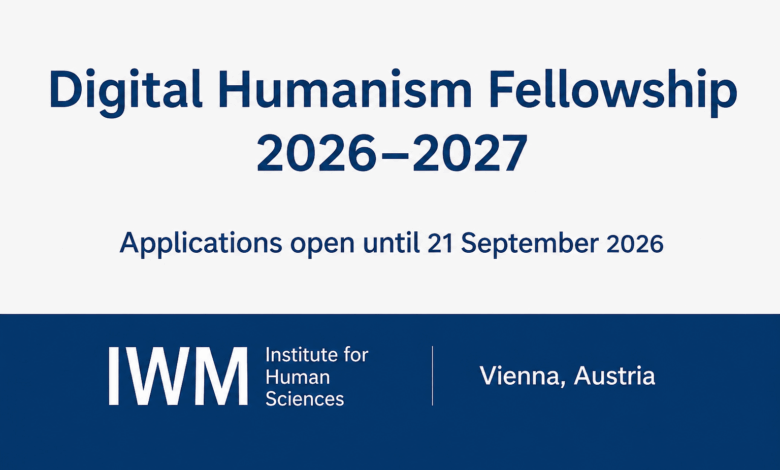
Table of Contents
The Institute for Human Sciences (IWM) is inviting applications for the Digital Humanism Junior Visiting Fellowship 2026–2027 in Vienna, Austria. The fellowship offers eligible doctoral researchers and recent postdoctoral researchers an opportunity to spend three consecutive months at the IWM between February and June 2027 while developing an independent research project focused on the relationship between technology, society and human values.
Selected fellows will receive a monthly stipend of €3,300 for postdoctoral candidates or €2,750 for candidates currently pursuing a doctoral degree. The application deadline is 21 September 2026 at 23:59 CEST.
ALSO READ: University of Melbourne Visiting Fellowship 2027 in Australia | Funded Fellowship Up to AUD $6,000. Apply Now
Digital Humanism Fellowship 2026–2027 at IWM: Opportunity Overview
The Digital Humanism Fellowship is part of the IWM’s Digital Humanism Program. It is designed for researchers examining how digitalization and technological development affect society, economics, politics, geopolitics and human life.
The fellowship is open across academic disciplines. However, applicants should understand that the program is focused on Digital Humanism, rather than simply using digital tools or technologies to conduct research in the humanities.
The selected Junior Visiting Fellows will:
- Spend three consecutive months at the IWM in Vienna.
- Conduct research related to digitalization and its broader societal implications.
- Develop their research project during their fellowship period.
- Join the IWM community of scholars.
- Participate in relevant activities at the Institute.
- Have access to office space, internet and in-house research facilities.
- Receive administrative support from the IWM.
The fellowship period will take place between February and June 2027 and will overlap with the Senior Digital Humanism Visiting Fellow.
About the Institute for Human Sciences
The Institute for Human Sciences (IWM) is based in Vienna, Austria, and brings together scholars and intellectuals working across different academic and social fields.
The Digital Humanism Program focuses on understanding and influencing the relationship between technology and humankind. Its approach emphasizes the importance of human rights, social well-being and human values when considering technological change.
For applicants, this means a strong proposal should not focus on technology in isolation. It should demonstrate why the research matters for people, societies, institutions, economies or political systems.
Who Is This Opportunity Suitable For?
The Digital Humanism Junior Visiting Fellowship is particularly suitable for:
- Doctoral researchers whose research addresses digitalization and society.
- Recent PhD graduates working on relevant research questions.
- Researchers in the humanities and social sciences.
- Scholars studying the societal, economic or geopolitical consequences of technological change.
- Researchers interested in interdisciplinary approaches to technology and human values.
- Applicants who can clearly explain how spending time at the IWM would advance their research.
The call is open to all academic disciplines, but the proposed research must fit the thematic focus of Digital Humanism.
Salary and Fellowship Benefits
The IWM provides different monthly stipends depending on the applicant’s academic status.
Postdoctoral researchers
Applicants who have defended their PhD by the application deadline can receive:
€3,300 per month
To qualify under this category, the PhD must have been obtained no more than four years before the application deadline.
Current doctoral researchers
Applicants who are still pursuing their doctoral degree can receive:
€2,750 per month
What does the stipend cover?
The fellowship stipend is intended to cover the fellow’s expenses during the research term. These include:
- Travel to and from Vienna
- Accommodation
- Health insurance
- Utilities
- Local transportation
- Telecommunications
- Research expenses
- Literature
- Conference fees
Applicants should therefore budget carefully before accepting the fellowship because these expenses are not separately listed as additional benefits.
Facilities provided by IWM
In addition to the stipend, the IWM provides visiting fellows with:
- Office space
- Internet access
- In-house research facilities
- Administrative services
- Access to the IWM scholarly community
- Opportunities to participate in Institute activities
Required Qualifications Explained
Applicants must meet the fellowship’s eligibility requirements.
Candidates must either:
- Be enrolled in a doctoral program; or
- Have obtained a PhD no more than four years before the application deadline.
For the 2026 application, the IWM specifies that postdoctoral candidates must have obtained their PhD not before 21 September 2022.
Applicants who have previously received an IWM fellowship must wait three academic years before applying for another fellowship.
The IWM also states that candidates cannot submit multiple fellowship applications during the same academic year.
Required Experience
The fellowship is research-focused, so applicants should be able to demonstrate a clear academic research profile.
The application requires a curriculum vitae including a publication list, meaning applicants should present their academic background, research experience and publications clearly.
More importantly, the proposed project needs to demonstrate:
- Clearly defined research objectives
- Awareness of existing research
- Appropriate research methods
- A realistic work plan
- A meaningful connection to Digital Humanism
- A clear reason why time at the IWM would benefit the project
Applicants should avoid treating the proposal as a general statement about artificial intelligence, social media or digital technology. The research needs to examine the broader relationship between digitalization and society.
What Research Areas Could Fit Digital Humanism?
The IWM describes Digital Humanism as an approach that examines and seeks to influence the complex relationship between technology and humankind.
Potentially relevant research can therefore involve questions concerning the intersection of digitalization with:
- Society
- Economics
- Geopolitics
- Politics
- Human rights
- Social well-being
- Human values
- Broader humanities and social sciences questions
The important factor is not simply whether a project involves technology. The project should explore a meaningful question about how technological change affects human beings, societies or institutions.
JOIN OUR WHATSAPP GROUP
Application Requirements
Applicants must submit their applications through the IWM’s online application form.
The required materials include:
1. Letter of motivation
The letter should explain:
- Why the project would benefit from time at the IWM.
- How the project connects with the IWM’s mission and research.
- What specific research or writing goals the applicant plans to achieve during the fellowship.
2. Project description
Applicants must provide a project description of no more than 550 characters including spaces.
This makes precision extremely important. The description should communicate the central research idea without unnecessary background information.
3. Project proposal
The project proposal can contain a maximum of 7,500 characters including spaces.
It must include:
- Project objectives
- Current state of research
- Research methods
- Work plan
4. Curriculum vitae
The CV must include a list of publications.
5. Two recommendation letters
Applicants need two letters of recommendation from scholars familiar with their academic work.
The recommendation letters are submitted directly by the recommenders. After the applicant submits the application, recommenders receive an automatic email containing a link to an online form.
All application materials must be submitted in English.
Important PDF and File Requirements
There is an important technical requirement that applicants should not overlook.
All attached documents must be combined into one single PDF, because the online application form permits only one attachment.
The IWM also states that attachment file names must use Latin characters only.
A technically incomplete submission could create an avoidable problem even when the academic content is strong.
How Competitive Is the Digital Humanism Fellowship?
The IWM does not publish a specific acceptance rate or number of applicants in the vacancy information provided.
However, applicants should approach this as a competitive academic fellowship because selection is based on both formal eligibility and thematic fit, with finalists selected by a jury of experts.
A strong academic record alone may not be enough. Applicants should focus on the quality and relevance of the proposed research project and explain specifically why the IWM is the right environment for that work.
The selection jury is not required to publicly justify its decisions or provide individual feedback to unsuccessful applicants.
How to Prepare Your CV
A strong CV for this fellowship should make it easy for reviewers to understand your academic trajectory.
Consider organizing it around:
Academic background
Clearly list your doctoral program, previous degrees and institutions.
Research experience
Highlight research projects that demonstrate your expertise and ability to conduct independent academic work.
Publications
Include your publications because the fellowship specifically requests a publication list.
Relevant academic activities
Include conferences, research appointments, academic collaborations and other activities that strengthen your research profile where applicable.
Keep the CV focused
Avoid filling the CV with unrelated information. The strongest version should reinforce your ability to complete the proposed Digital Humanism research project.
How to Strengthen Your Project Proposal
The project proposal is likely to be one of the most important parts of the application.
Start by identifying the central research question. Then explain what the project intends to accomplish and why the question matters.
Your proposal should clearly address the four elements requested by IWM:
Objectives: What exactly will the research investigate or produce?
State of research: What has already been studied, and where does your project contribute?
Methods: How will you conduct the research?
Work plan: What will you realistically accomplish during the three-month fellowship?
Applicants should also explain the connection between their project and the IWM’s Digital Humanism research agenda.
Common Application Mistakes
Applicants should avoid several preventable mistakes.
Submitting by email
The IWM states that applications submitted by email will not be considered. Use the official online application system.
Exceeding character limits
The project description has a 550-character limit, while the project proposal has a 7,500-character limit, including spaces.
Sending multiple attachments
The application form only allows one attachment, so required documents must be combined into a single PDF.
Ignoring the recommendation process
Recommendation letters must be submitted directly by the recommenders. Applicants should contact their referees early enough to allow them to complete the process before the deadline.
Weak connection to Digital Humanism
A project simply involving digital tools or technology may not fit the fellowship. Applicants should demonstrate how their research addresses the relationship between digitalization and society.
Failing to explain the value of the IWM
The motivation letter should not simply repeat the project description. Applicants need to explain what they expect to accomplish specifically through time at the Institute.
Leaving the application until the deadline
Because the application involves a proposal, CV, motivation letter and two external recommendations, starting early is particularly important.
Application Timeline
The key dates provided by IWM are:
Application deadline: 21 September 2026 at 23:59 CEST
Jury decision notification: By 30 November 2026
Fellowship period: Three consecutive months between February and June 2027
Applicants should check the official application system for any updates before submitting.
Career Paths After the Fellowship
A fellowship such as this can strengthen an academic career by giving researchers additional time to develop their research and engage with an international scholarly community.
Depending on an individual’s background and career goals, relevant longer-term pathways may include:
- University research and teaching
- Postdoctoral research
- Academic publications
- Research institutes and think tanks
- Policy research
- Technology and society research
- Digital policy
- Human rights and technology research
- Interdisciplinary research
- International research collaborations
The fellowship itself does not guarantee employment or a future academic position. Its value will depend largely on how effectively the fellow uses the research period and scholarly network.
Similar Opportunities
Applicants who are not selected, or who want to build a broader academic fellowship strategy, can also explore:
- Visiting research fellowships
- Postdoctoral fellowships
- Digital policy fellowships
- Technology and society research programs
- Humanities and social sciences fellowships
- Research residencies at international institutes
- Academic fellowships focused on technology, democracy and human rights
When comparing opportunities, researchers should pay particular attention to eligibility dates, research themes, funding levels, location and whether the fellowship provides institutional research facilities.
Official Application Information
The Digital Humanism Fellowship 2026–2027 is administered by the Institute for Human Sciences (IWM) in Vienna, Austria.
Applications must be submitted through the official IWM online application system. Email applications are not accepted.
Position/Opportunity: Digital Humanism Junior Visiting Fellowship
Organization: Institute for Human Sciences (IWM)
Location: Vienna, Austria
Fellowship period: Three consecutive months between February and June 2027
Postdoctoral stipend: €3,300 per month
Doctoral stipend: €2,750 per month
Application deadline: 21 September 2026, 23:59 CEST
Decision notification: By 30 November 2026
Application language: English
Official fellowship page: https://www.iwm.at/calls/digital-humanism-fellowship
Contact: Kasper Nowak, Fellowship Program Coordinator — fellowships@iwm.at
Final Thoughts
The IWM Digital Humanism Fellowship 2026–2027 is a strong opportunity for doctoral researchers and recent PhD graduates whose work examines the relationship between digitalization and society.
The €2,750–€3,300 monthly stipend provides financial support during the three-month research period, while the IWM also provides office space, internet, research facilities and administrative services.
For prospective applicants, the most important step is to develop a research proposal that is both academically strong and clearly connected to the Digital Humanism Program. A focused project, carefully prepared application documents and well-chosen academic referees can help present a much stronger application.
With the 21 September 2026 deadline approaching, eligible researchers should begin preparing their proposal, CV, motivation letter and recommendation requests early rather than waiting until the final days.




One Comment