Agroforestry for Climate Resilience and Sustainable Landscapes Online Course 2026 | Free Online Training Opportunity

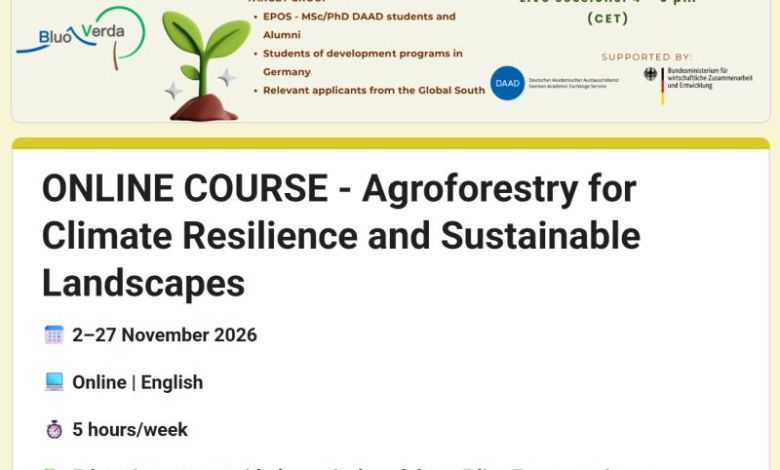
Table of Contents
The Agroforestry for Climate Resilience and Sustainable Landscapes Online Course 2026 is an online learning opportunity for students, researchers, practitioners, scientists, lecturers and professionals interested in agroforestry, climate resilience, biodiversity conservation, sustainable landscapes and integrated landscape management.
The online course will take place from 2 to 27 November 2026 and will be delivered in English. Participants should expect to dedicate approximately 5 hours per week to the training through an e-learning system combining theoretical learning modules with five live Zoom sessions.
Women are particularly encouraged to apply.
Application deadline: 4 October 2026 at 23:59 CET.
ALSO READ: Royal Society Career Development Fellowship 2027 | Up to £703,800 Postdoctoral Research Fellowship in the UK
About the Agroforestry for Climate Resilience Online Course
The Agroforestry for Climate Resilience and Sustainable Landscapes course focuses on how agroforestry approaches can contribute to landscapes that are more resilient, biodiverse and sustainable.
Agroforestry integrates trees with agricultural systems and can provide ecological, social and economic benefits. Through this online course, participants will explore the relationship between agroforestry, climate resilience, sustainable landscapes, biodiversity, ecosystem services and sustainable livelihoods.
The training is also designed to provide practical perspectives that participants can apply in different professional, academic and environmental contexts.
Agroforestry Online Course 2026 Overview
- Course: Agroforestry for Climate Resilience and Sustainable Landscapes
- Format: Online
- Language: English
- Dates: 2–27 November 2026
- Study commitment: Approximately 5 hours per week
- Learning format: E-learning modules and live Zoom sessions
- Live sessions: 5
- Application deadline: 4 October 2026
- Deadline time: 23:59 CET
- Women: Particularly encouraged to apply
What Participants Will Learn
The Agroforestry for Climate Resilience course covers several important areas related to sustainable agriculture, environmental management and climate adaptation.
Principles of Agroforestry
Participants will develop an understanding of the principles of agroforestry and explore how agroforestry contributes to the Sustainable Development Goals (SDGs).
Biodiversity and Ecosystem Services
The course will examine how agroforestry can support biodiversity conservation and ecosystem services. Participants will explore the environmental functions associated with integrating trees and agricultural systems.
Sustainable and Climate-Resilient Landscapes
Participants will explore integrated landscape approaches, restoration approaches and strategies for developing more sustainable and climate-resilient landscapes.
Economic Opportunities and Sustainable Livelihoods
The course will also examine economic opportunities associated with agroforestry, including sustainable livelihoods and market potential.
Environmental Ethics and Participation
Participants will gain insight into the role of environmental ethics and participatory approaches in agroforestry and land management.
Ecological, Social and Economic Resilience
A broader objective of the training is to help participants understand how agroforestry can contribute to ecological, social and economic resilience.
Who Is the Agroforestry Course Suitable For?
The Agroforestry for Climate Resilience and Sustainable Landscapes Online Course 2026 may be relevant to people working or studying in areas such as:
- Agroforestry
- Agriculture
- Forestry
- Ecology
- Environmental science
- Climate resilience
- Sustainable development
- Landscape restoration
- Biodiversity conservation
- Natural resource management
- Sustainable livelihoods
- Agricultural development
- Integrated landscape management
The application form allows applicants to identify their current status, including Bachelor students, Master students, Doctoral students, scientists or university lecturers, and practitioners.
Applicants are also asked to indicate their field of study or work and their existing level of knowledge about agroforestry, climate resilience, integrated landscape management and participatory approaches.
Course Structure and Weekly Commitment
The online course will run from 2 November to 27 November 2026.
Participants should plan for approximately 5 hours per week.
The training combines:
- Theoretical e-learning modules
- Independent online learning
- Practical perspectives
- Five live Zoom sessions
The live sessions are scheduled for 4:00–6:00 PM CET.
Live Zoom Session Dates
- LS1: 3 November 2026
- LS2: 10 November 2026
- LS3: 17 November 2026
- LS4: 24 November 2026
- LS5: 26 November 2026
Applicants should check their schedules carefully before applying because participation requires the necessary time and commitment.
Eligibility and Applicant Information
The application form requests information about applicants’ academic, professional and geographical backgrounds.
Applicants will be asked to provide:
- First name and surname
- Email address
- Gender
- Current country of residence
- Country of nationality
- Current academic or professional status
- Field of study or work
- DAAD status
- University attended
- Organisation, where applicable
- Current level of knowledge about the course topics
The form also asks applicants to provide a personal motivation statement of no more than 200 words explaining why they are interested in the course and how they intend to apply what they learn.
DAAD Status and EPOS Information
The application form includes questions about applicants’ DAAD status and whether they are currently receiving DAAD funding.
Applicants may be asked whether they:
- Currently receive DAAD funding and are enrolled in an EPOS programme
- Currently receive DAAD funding but are not enrolled in an EPOS programme
- Are DAAD alumni
- Have never received DAAD funding
Applicants connected to a Development-Related Postgraduate Courses (EPOS) programme may also be asked to provide the name of their EPOS programme.
How to Prepare Your Application
Applicants should prepare their information before starting the application form.
Particular attention should be given to the 200-word motivation statement. A strong response should clearly explain your interest in agroforestry, climate resilience or sustainable landscapes and describe how the knowledge gained from the course could be applied to your studies, research, professional work or community activities.
Keep the motivation statement within the requested 200-word limit.
Availability Requirements
Because the course includes five live Zoom sessions, applicants should make sure they can participate in the scheduled sessions.
The application form asks applicants to indicate whether they will be available for all sessions or whether they may miss one or more sessions.
The scheduled sessions take place from 4:00 to 6:00 PM CET, so applicants should convert the time to their local time zone before applying.
JOIN OUR WHATSAPP GROUP
Career and Professional Relevance
Knowledge of agroforestry, climate resilience and sustainable landscape management can be relevant to professionals working across agriculture, forestry, conservation, climate adaptation and sustainable development.
The training can also complement academic interests in agricultural sciences, forestry, ecology, environmental sciences and related disciplines.
Participants can potentially use the knowledge gained from the course when working on projects involving:
- Climate adaptation
- Landscape restoration
- Sustainable agriculture
- Biodiversity conservation
- Ecosystem management
- Rural development
- Sustainable livelihoods
- Natural resource management
- Environmental planning
Why Agroforestry Matters for Climate Resilience
Agroforestry is increasingly relevant to discussions around sustainable land management because it connects agricultural production with trees, biodiversity and ecosystem functions.
The Agroforestry for Climate Resilience course provides participants with an opportunity to examine these connections from ecological, social and economic perspectives.
Rather than focusing only on agricultural production, the course considers the wider landscape and the relationships between communities, ecosystems, livelihoods and land management.
Application Deadline
The deadline to apply for the Agroforestry for Climate Resilience and Sustainable Landscapes Online Course 2026 is:
4 October 2026 at 23:59 CET.
Applicants are encouraged to complete the application before the deadline and ensure that all required information is accurately provided.
How to Apply for the Agroforestry Online Course 2026
Interested applicants should complete the online application form and provide the requested personal, academic and professional information.
The application also requires applicants to explain their motivation for joining the training and how they intend to apply the knowledge gained.
Apply Now: Complete the official online application form provided for the Agroforestry for Climate Resilience and Sustainable Landscapes Online Course 2026.
Final Thoughts
The Agroforestry for Climate Resilience and Sustainable Landscapes Online Course 2026 offers a focused learning opportunity for people interested in agroforestry, climate resilience, biodiversity, sustainable landscapes and integrated land management.
With online theoretical modules, five live Zoom sessions and a commitment of approximately five hours per week, the course is designed to provide participants with broader perspectives on the ecological, social and economic dimensions of agroforestry.
Women are particularly encouraged to apply.
Application deadline: 4 October 2026 at 23:59 CET.